Papaya-Lemon Popsicles

papaya lemon popsicles

Oh, I’ve been looking forward to these popsicles! In Mexico I fell in love with paletas – it’s so hard to say which was my favourite, but I definitely loved the lemon ones. I found these overripe papayas at Granville Island for $1 a piece – awesome deal! So this awesome find, combined with the vancouver weathergorgeous hot weather we’re experiencing right now, and with the abundance of lemons I bought the other day, I knew just what to do with them. Plus I have report cards to write, and I’ll do almost anything rather than that job.

When I was a kid the thing I looked forward to in my stocking was a papaya. They weren’t easy to find in Vancouver in the 70’s, so it was a real treat. We would squeeze a little lemon juice on them, and a tiny sprinkle of sugar. There popsicles are reminiscent of those Christmas mornings. I have used gelatine in these, so they have a softer bite, just like my Oma used to add to her raspberry popsicles.

Here’s a link to the popsicle maker I bought on Amazon. It does the job, and the popsicles look pretty!

What you need:

  • about 3 cups of very ripe papaya
  • the juice of 2-3 lemons, about 3/4 of a cup
  • 1/4 cup granulated sugar (this makes the popsicles not very sweet – add more if you have a sweet tooth!)
  • 1 package gelatine, 2 tablespoons

What you do:

  1. Peel and seed the papaya; cut into rough chunks and place in a blender.
  2. Add the lemon juice to the blender.
  3. Heat  1/3 cup water and 1/4 cup sugar in a small pot until the sugar has dissolved.
  4. Sprinkle the gelatine over 1/4 cup of cold water. Pour 1/4 cup of boiling water over the gelatine and stir continually until the gelatine has dissolved.
  5. Puree the papaya for a few seconds, then add the sugar and gelatine mixtures. Puree for a few seconds, or longer if you prefer no chunks in your popsicles.
  6. Pour the popsicles into moulds and freeze for about 6 hours. This is the hardest part!
  7. Enjoy!

P1060307

Paletas - trustinkim
Paletas at La Michoacana in Puerto Vallarta


Korean Beef Bulgogi

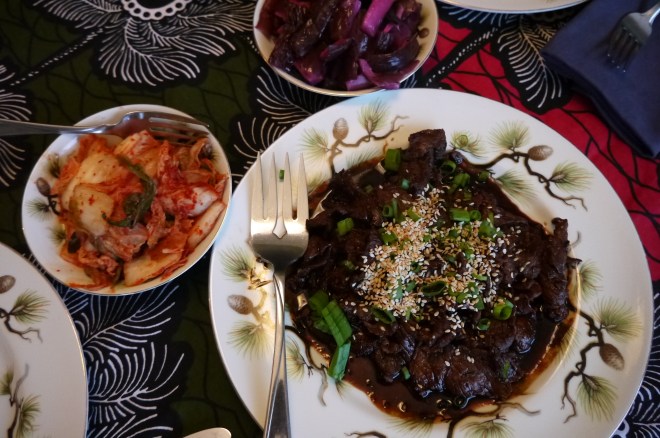
Korean Beef Bulgogi - trustinkimKorean beef bulgogi is marinated for a few hours, making it very tender, and then cooked quickly and dipped into sauce before eating. The marinade plus the dip provide the dish with a ton of flavour. We served it on white rice with a spicy kimchi, purple pickled cucumbers, and a cucumber salad. The only tricky part was getting the beef sliced really thinly.

It was fun to go to the Asian supermarket and choose some prepared pickled side dishes. I also bought an Asian pear that I was going to cut into matchsticks as a garnish, but totally forgot about it.

I found this in a cookbook called The Global Grill by Kathleen Sloan. It serves six people.

What you need for the beef marinade:

  • 2 & 1/2 pounds (just over a kilogram) beef strip loin
  • 1/2 cup light light sauce
  • 1/2 cup dark soya sauce
  • 1/2 cup water
  • 1 green onion, finely chopped
  • 3-4 cloves garlic, minced
  • 1 tablespoon sugar
  • 1 tablespoon minced ginger root
  • 1/4 teaspoon freshly ground black pepper
  • 2 tablespoons sesame seeds, toasted and ground

What you need for the dipping sauce:

  • 2 cloves garlic, minced
  • 1 green onion, finely chopped
  • 3 tablespoons dark soya sauce
  • 2 tablespoons water
  • 2 tablespoons rice wine or mirin
  • 1 tablespoon sesame seeds, toasted and ground
  • 1 tablespoon hot chili sauce (I used sriracha)
  • 2 teaspoons sesame oil
  • 2 teaspoons sugar
  • 1 teaspoon bean paste

What you need for serving:

  • rice (we used 2 cups of jasmine rice)
  • sesame seeds for garnish
  • green onions for garnish
  • side dishes such as kimchi, pickled vegetables, salad

What you do:

  1. Combine all the marinade ingredients in a container with a lid.
  2. Slice the beef as thinly as you can, using a very sharp knife. If you put the beef in the freezer for about 20 minutes before slicing it is easier to get the thin slices.
  3. Cover the beef with the marinade and refrigerate for about four hours.
  4. Combine all the ingredients for the sauce.
  5. Return the beef to room temperature before cooking.
  6. Preheat a grill or frying pan to high heat. Cook the beef for about 1 & 1/2 minutes per side. Serve it right away with the dipping sauce.

Garlicky & Spicy Sugar Snap Peas

Sugar Snap Peas - trust in kim

This is one of my favourite quick veggie recipes. It’s garlicky, salty, and a little spicy. Or a lot spicy if you like it that way. It’s a quick way to add some healthy and yummy green to your meal. Feel free to play with the amounts of the ingredients. I never measure anything for a recipe like this, so just do what seems right to you!

What you need:

  • sugar snap peas (substitute with snow peas)
  • sesame oil
  • 2-3 cloves garlic
  • a dash or two of soya sauce
  • a dash of hot sauce (I used sriracha)
  • a few dashes of your favourite vinegar (I usually use an Asian or balsamic vinegar)

What you do:

  1. Clean the snap peas and snap their ends off. Peel and slice the garlic.
  2. Heat a frying pan on medium heat and drizzle in a little sesame oil. Spread it around with your cooking utensil.
  3. Add the sliced garlic and cook briefly, carful not to burn it.
  4. Add the snap peas to the pan and cook briefly.
  5. Add some soya sauce, hot sauce and vinegar. Stir to combine with the snap peas. Cook for a minute or so, but not too long. The snap peas should still have a bit of crispness to them.
  6. Eat them up! Yum!

You could also garnish them with some toasted sesame seeds.

Here’s a link to a site that explains the difference between snow, snap, and garden peas.


How to Hard-Cook an Egg

P1050353

I know it seems too simple to bother writing about, but I really do believe there is a “right” way to hard-cook an egg. Most mornings I start my day with a hard-cooked egg since it’s a good source of protein, and when cooked this way . . .  the Right Way . . . it is tender and delicious.

I used to call these hard-boiled eggs, but I stopped using the word ‘boiled’ when I found the Right Way stopped boiling them. You see, eggs don’t like to be cooked at high temperatures; they turn tough when you boil them. This method is really easy, and the results are much better.

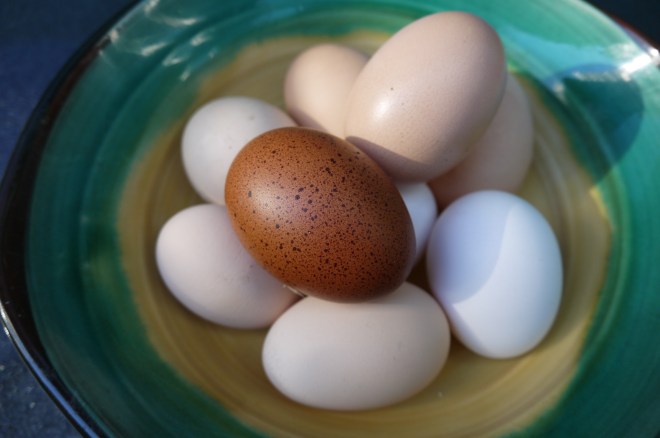
I have also been using free-range organic eggs for a while, and I believe the flavour is much better. The eggs in the photo are from London Heritage Farm in Steveston, BC. It’s a great place to cycle to for tea and a scone in the their tea house, and a walk through the garden.

What you need:

  • one large free-range organic egg
  • salt and freshly ground pepper – optional

What you do:

  1. Place the egg in a small pot and add enough water to cover the egg. Place the pot, with the lid on, on high heat and bring to a simmer – just before it begins to boil, turn the heat off.
  2. Keep the pot on the burner that has been turned off, with the lid on. Set a timer for 11 minutes. (Give it a few extra minutes at high altitudes)
  3. Pour the hot water out of the pot, then cover the egg with cold water for a moment.
  4. Crack and peel the egg, salting and peppering if desired. Eat it while it’s hot!

You can use the same method to make devilled eggs, egg salad sandwich, or any other recipe that calls for hard-boiled eggs.


Chewy Oat Cookies

chewy oat cookies -trust in kim

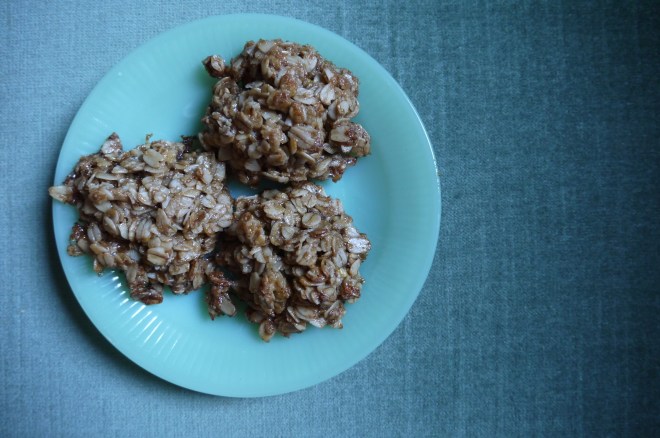
My brother reminded me about these cookies from our childhood the other day. They are chewy and almost caramel in the middle, a little crispy on the outside, and really really simple to make. My mom made them when we were little, and neither of us had eaten them for a long time until my brother started making them recently. Of course I had to ask him to send me the recipe so I could try them out too.

On Friday night I mixed up the batter, because it needs to sit in the fridge for a little while, and then it took minutes the next morning to mound the mixture onto a baking pan and bake them up. I brought them to Community Garden work party, and my fellow fence-builders were very happy to try out these treats.

What you need:

  • 2 cups rolled oats
  • 1 cup brown sugar
  • 1 egg
  • 1/2 cup canola oil
  • 1/2 teaspoon salt
  • 1/2 teaspoon almond extract

What you do:

  1. Combine all the ingredients in a bowl using a wooden spoon.
  2. Cover and refrigerate the mixture for about an hour, or overnight.
  3. Preheat the oven to 350F.
  4. Line a baking pan with parchment paper, then form the cookies into mounds. If you have a 2 tablespoon ice-cream scoop this could be used, or just a large spoon. You will find that bits of rolled oats scatter a bit, so just press them into the mound with your hands. You should get 12-15 cookies and be able to fit them on one pan.
  5. Bake for 12- 15 minutes. The edges should look caramely and bubbly, which will become crispy as they cool.
  6. After removing from the oven allow them to cool on the baking pan. After they are cool the edges will be crispy, and the inside will be chewy.
  7. Enjoy!
raw oat cookies - trust in kim
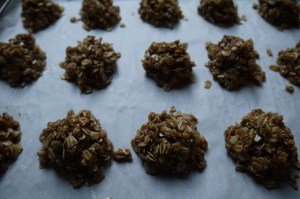
the raw cookies mounded on the pan
mom & dad dancing
my parents and their friends out for the evening, way back when


Beet and Gherkin Salad

Beet and Gherkin Salad - trust in kim

This beautiful salad comes to us from my new favourite cookbook, Mamushka: A Cookbook by Olia Hercules. The book is a beautiful and delicious-looking collection of recipes from Ukraine and Eastern Europe. The author has a great love for vegetables, so there are many recipes where you can get your fill of them, along with lots of meaty recipes.

This salad is very popular in Russia, although typically made with boiled vegetables rather than roasted. I love roasted vegetables, so a salad made with them was a must-try for me. It is simple, with just some salt, pepper and unrefined sunflower oil for added flavour. I was able to find a bottle of unrefined sunflower oil at Whole Foods; it has a nice nutty flavour. If you can’t find it, or don’t like it, you can substitute with canola oil.

The only change I will made to this recipe is the amount of red onion. Because I found the onion had too strong a bite, I will only add a few tablespoons when I make this again. If you find a milder and sweeter tasting red onion, feel free to add half of it.

What you need:

  • 2 tablespoons refined sunflower oil
  • 1 lb beets, peeled and diced into 6mm cubes (I used mostly golden beets, and a few red ones)
  • 315 grams Yukon gold potatoes, peeled and diced into 6mm cubes
  • sea salt flakes and freshly ground pepper
  • 1/3 cup frozen peas
  • 1-2 tablespoons red onion
  • 1 large dill pickle (gherkin) diced
  • 2 tablespoons unrefined sunflower oil

What you do:

  1. Preheat the oven to 350F.
  2. Combine the beets and potatoes with the refined sunflower oil, salt and pepper. Spread onto a baking sheet and roast until they start to caramelize, about 40 minutes.
  3. Allow the beets and potatoes to cool.
  4. Blanch the peas in salted boiling water for about a minute, then drain them.
  5. Combine all the ingredients, and then taste to adjust seasonings.
  6. Serve at room temperature.

Mexican Brown Rice & Beans with Squash and Chorizo

Beans, Rice, Chorizo & Squash

This meal is awesome! So flavourful – a little bit spicy, or a lot if you prefer. But it’s not just spicy – I love the beans in this recipe, prepared like I would a soup stock, with garlic, onion and other ingredients to make them irresistible. The rice, as well, has onion, garlic, hot peppers and flame-roasted tomatoes to boost the flavour. And the Mexican chorizo and cotija cheese add some salty goodness. Add a salsa of your choice, and you’ve got a feast!

I’m not going to lie to you – there are a lot of steps here. Each of the parts of the recipe can be made to use in other meals; the beans and rice would be great on their own, and the rice, squash and chorizo would be great together. On another occasion I made the beans and rice with a beautiful pulled beef dish (recipe to come…). Use a vegetable broth and omit the chorizo for a vegetarian meal.

The beans can be made ahead of time and reheated; they take the longest amount of time. The timeline looks like this:

  • soak the beans the night before
  • make the beans ahead of time OR give them 1 & 1/2 hours or more to cook
  • bake the rice
  • if you are making your own salsa, do that (salsa fresca, salsa verde asado)
  • roast the squash
  • prepare the Mexican sausage
  • put it all together and top with Mexican cotija cheese, Mexican sausage, cilantro, and a wedge of lime

I cobbled this recipe together from a variety of sites, making a bunch of changes that are too numerous to list. The butternut squash is taken from a taco recipe, the beans are adapted from a Saveur recipe, and the rice is a combination of a Rick Bayless recipe and a  Whole Foods recipe.

What you need for the beans:

  • 2 cups dried pinto beans
  • about 8 cups chicken stock, or water and chicken bouillon cube
  • 1 stalk celery
  • 1 carrot
  • 1 clove garlic, smashed
  • 1 whole jalapeño
  • 12 small sweet onion
  • 2 bay leaves
  • salt and pepper to taste

What you need for the rice:

  • 1 sweet onion, diced
  • 3 cloves garlic, minced
  • 1 tablespoon olive oil
  • 2 jalapeño peppers, sliced
  • 1 & 1/2 cups brown rice
  • 1 teaspoon dried ancho pepper
  • 2 cups chicken broth or water (with chicken boullion added)
  • 1 & 1/2 cups fire-roasted tomatoes
  • 1 teaspoon salt

What you need for the squash:

  • 1 butternut squash
  • 2 cloves garlic, minced
  • 1/2 dried ancho pepper, snipped into small pieces with kitchen shears
  • olive oil
  • 1/2 teaspoon oregano
  • 1/5 teaspoon salt
  • 1/4 teaspoon cumin seeds

What you need for the Mexican Sausage:

  • 2-3 cured Mexican sausages (in Vancouver Armando’s Meats at Granville Island has excellent sausages)
  • 1/2 sweet onion, chopped
  • olive oil

Other things you need:

  • Mexican cotija cheese (salty and crumbly – yum!)
  • lime wedges
  • cilantro
  • salsa of your choice (homemade or store-bought)
  • your favourite hot sauce that people can add as they see fit – some of us like it hot!

What you do for the beans:

  1. Soak the beans in a large pot of water the night before you plan to cook them.
  2. Drain the beans and add the 8 cups of chicken broth or water and chicken bouillon. Add the celery, carrot, onion, garlic, jalapeño and a bit of salt. Bring to a boil, then lower the heat to a simmer. Cook for 1 hour and 45 minutes, or until the beans are soft. Add a little boiling water if they start looking too dry.
  3. At this point I decided to cook off a lot of the liquid by raising the heat and stirring. This way I kept a ton of flavour in the beans. Alternatively, you could drain the liquid and reserve it for making soup.
  4. Discard the vegetable pieces and bay leaves.

What you do for the rice:

  1. Preheat the oven to 350F.
  2. Use an oven-proof pot with a lid or a dutch oven for the rice. Add the olive oil to the pot on medium-high. When it is hot, add the onion and cook, stirring, for a few minutes. Add the garlic and cook for another minute or two.
  3.  Add the jalapeño pepper, rice, and the whole dried ancho pepper. Stir to combine, then add the tomatoes, broth or water and chicken bouillon, and the salt. Bring to a boil then cover with a lid and bake for one hour.
  4. Remove the rice from the heat and let sit for 10 minutes, or until the rest of the meal is prepared.
  5. Fluff the rice with a fork and cover until ready to serve.

What you do for the squash:

  1. While the rice is cooking, begin to prepare the squash. Turn the oven heat to 400F when the rice is done; if you have room in the oven you could cook the squash with the rice, letting it bake a little longer than suggested here.
  2. Peel and dice the squash. Place it in a large bowl. Drizzle it with olive oil, then add the garlic, ancho pepper, oregano, salt, and cumin seeds. Toss to combine.
  3. Arrange the squash in a single layer on a baking tray. Bake for 20-25 minutes, or until it begins to get a little browned.

What you do for the sausage:

  1. Heat a frying pan to medium-high and add a drizzle of olive oil. Add the onion and fry until it begins to brown. In the meantime, crumble the sausage into small bite-sized pieces.
  2. Add the sausage to the onions and cook until lightly browned. Keep hot until serving.

You can either serve family style, letting everyone put their plates together as they wish, or dish it up: rice and beans side by side, some squash and chorizo on top, sprinkled with a little cheese. Top with cilantro and place a wedge of lime on it for people to squeeze over the whole thing. Serve the salsa on the side, so people can add as much as they wish.

Enjoy!

Chicken and Vegetable Tagine

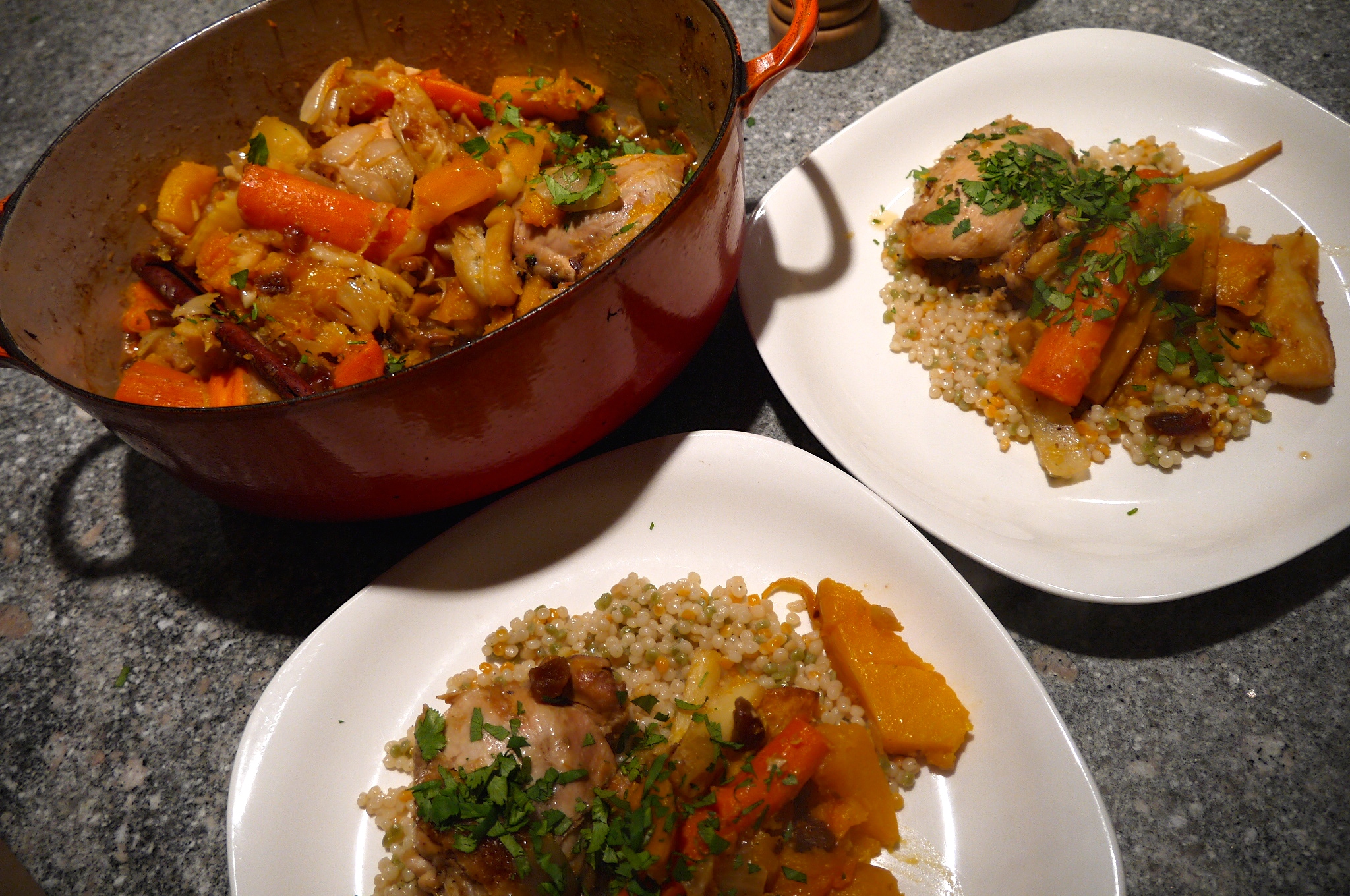
chicken and vegetable tagine - trust in kimA few months ago I made some preserved lemons , knowing that I would make a tagine one day – some things have to be planned ahead! So I had the beautiful sunny gems waiting in my fridge to use in this chicken and vegetable tagine, and they sure did make this recipe shine.

The recipe I ended up with was is amalgamation of two recipes I found online, here and here, and then a bit of my own experimentation. I really wanted it to be full of a variety of vegetables, and tons of flavour.

You could omit the chicken to make this a lovely vegetarian dish. I would probably throw some toasted nuts on top to add some protein.

I served the tagine on Israeli couscous, which have a nice pasta-like bite to them, but you could also serve it on regular couscous or rice.

A note about the tagine:

Tajine_potter

A tagine is a crockery vessel with a conical lid. I do not own a tagine, nor do I have room in my tiny kitchen to store one, so I have used a le Creuset lidded pot in its place. I’m sure so much of this recipe is inauthentic (yet awesome!), so using the wrong vessel is probably fine. Use any large lidded dish you have that can be used on both the stove-top and in the oven.

What you need:

  • 4-6 skinless, bone-in chicken thighs
  • 2 tablespoons olive oil
  • 1 large shallot
  • 2 cloves garlic
  • 1 tablespoon grated fresh ginger
  • 1 teaspoon cumin
  • 1 teaspoon coriander seeds, lightly crushed
  • 2 small cinnamon sticks
  • pinch of saffron
  • 1 teaspoon ground ginger
  • pinch of dried crushed chili flakes
  • 2 cups chicken stock
  • 2 small handfuls of dried apricots, chopped
  • 1 preserved lemon (optional)
  • 1 tablespoon honey
  • 1 sweet onion, cut into about 8 wedges
  • 1 small butternut squash, cut into 3-cm thick wedges
  • 3 carrots, cut into 4-5 cm long chunks
  • 2 parsnips, cut into 4-5 cm long chunks
  • 1 red pepper, cut into 2 cm wide strips
  • salt, to taste
  • cilantro

What you do:

  1. Preheat the oven to 400F.
  2. Place the onion wedges, butternut squash, carrots, parsnips and red pepper on a baking tray. Drizzle with olive oil and place in the oven to roast. This will take anywhere from 20-40 minutes. It’s okay if not all the vegetables are cooked through, but they should get some colour.
  3. Salt the chicken pieces.
  4. Heat 1 tablespoon of olive oil in a large skillet or a dutch oven with a lid, on medium high heat, then add the chicken. Brown the chicken on both sides, then remove it from the pan. The chicken does not need to be cooked all the way through, as you will continue the cooking process later.
  5. Lower the heat to medium-low and add the shallot and ginger to the pan. Cook until the shallot has browned.
  6. Add the fresh ginger, cumin, coriander seeds, cinnamon, saffron, chili, and ground ginger to the pan and cook until fragrant.
  7. Cut the peel off the preserved lemon and discard all the inside bits. Chop the lemon peel into about 1cm pieces.
  8. Add the chicken stock, honey, apricots, and preserved lemon to the pan, and then add the chicken back to the pan so it is mostly submerged in the broth. Simmer the chicken until the vegetables are ready.
  9. Add the roasted vegetables to the pot with the chicken. Gently combine them so they don’t break up. Put a lid on the skillet or dutch oven and place in the oven for 20-30 minutes, until the flavours have had a chance to mingle, and the chicken and vegetables have cooked all the way through.
  10. Serve on couscous or rice, garnished with cilantro.

Enjoy!


Salted Caramels

salted caramels - trust in kim

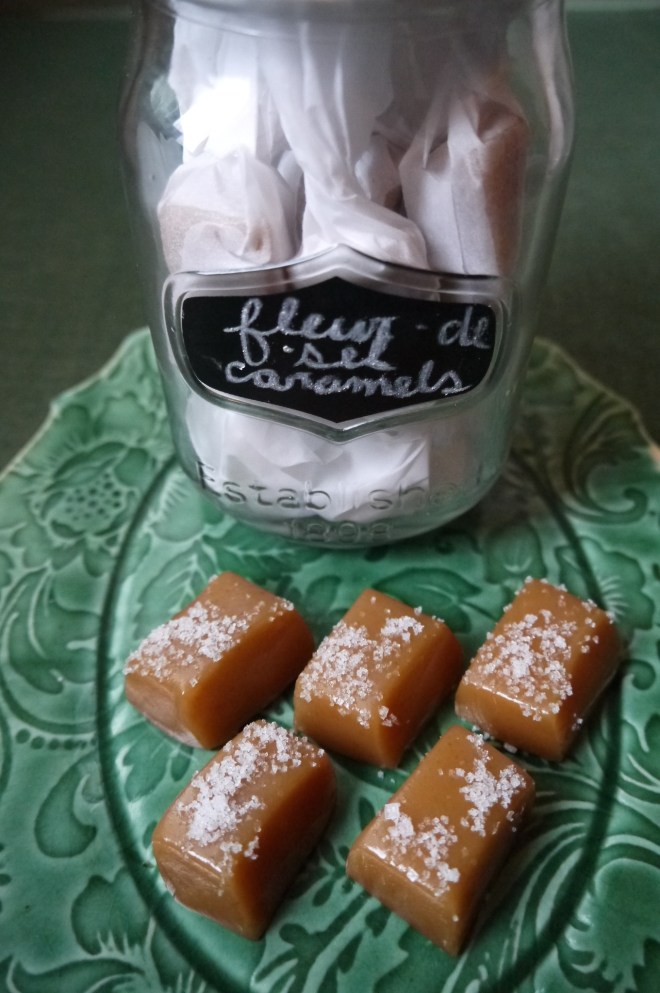
My mom likes to buy salted caramels, so I thought this year at Christmas I would surprise her and make her some of these fleur-de-sel caramels. These are so addictive! And they look pretty wrapped up in parchment paper, like little Christmas crackers.

This recipe isn’t difficult, but it does take a bit of patience to allow it to cook slowly. If you have some good music playing the time will fly by.

A candy thermometer is helpful but not essential in making these. I’ve had problems in the past with a candy thermometer that is not accurate, so I recommend testing the accuracy of your thermometer by placing it in boiling water – it should read 212F.

What you need:

  • 2 cups granulated sugar
  • 2 cups heavy cream (I used Avalon organic cream)
  • 1 cup light corn syrup
  • 1/2 teaspoon salt
  • 5 tablespoons butter
  • 1 teaspoon vanilla
  • fleur se sel
  • parchment paper
  • optional: 3 oz chocolate (I used 2 oz semi-sweet and 1 oz bitter-sweet)

What you do:

  1. Line a 9×9-inch pan with lightly buttered parchment paper.
  2. Combine the sugar, syrup,salt and one cup of the cream in a large pot. Place on medium heat, stirring constantly with a wooden spoon or silicone spatula until it boils. This may take a while, but make sure you don’t raise the heat to hurry it up – it needs to stay on medium
  3. As the sugar mixture continues to boil, slowly drizzle in the cream, continuing to stir. Reduce heat to medium-low and continue to boil for 5-6 minutes, stirring little.
  4. Add the butter, 1 tablespoon at a time so the mixture keeps boiling, and stir until melted.
  5. For the next steps you need to have patience, as you will need to stir from time to time for about 30-40 minutes.  Continue boiling over medium-low heat, stirring occasionally.  You will begin to see the mixture turn a more caramel-brown colour.  If you’ve got a candy thermometer, you want it to read 250F.  If you don’t have one, you can get a bowl of ice water and place a drop of the mixture into it.  When it forms a “firm ball” in the ice water, take it off the heat right away. After about 40 minutes I finally turned the heat up a little higher because it still hadn’t reached the right temperature and I was running out of time, but they turned out perfectly.
  6.  After removing from the heat, immediately stir in the vanilla.
  7. Pour immediately into the parchment-lined pan.  Just pour it in and don’t scrape the caramel from the bottom of the pot, to avoid crystallization.  Of course you can scrape the remaining bit out into another container and eat it – it tastes great too!
  8. Allow the caramel to cool completely, then remove it from the pan by pulling up the parchment paper.
  9. With a lightly buttered knife, cut into desired shapes.  (At this point if you are going to dip the caramels in chocolate you will do that.) Press the caramels into the fleur de sel so they have a little bit on one side.
  10. Parchment paper is great for wrapping the individual caramels. Just cut it into rectangles and twist the ends up. I like to use a piece of parchment to pick up the caramels when I am working with them to avoid getting fingerprints on them.
  11. Enjoy! And share!

While making these I listened to and sang along to Whitehorse’s album, The Fate of the World Depends on this Kiss.

Homemade Irish Cream (Bailey’s)

P1050879

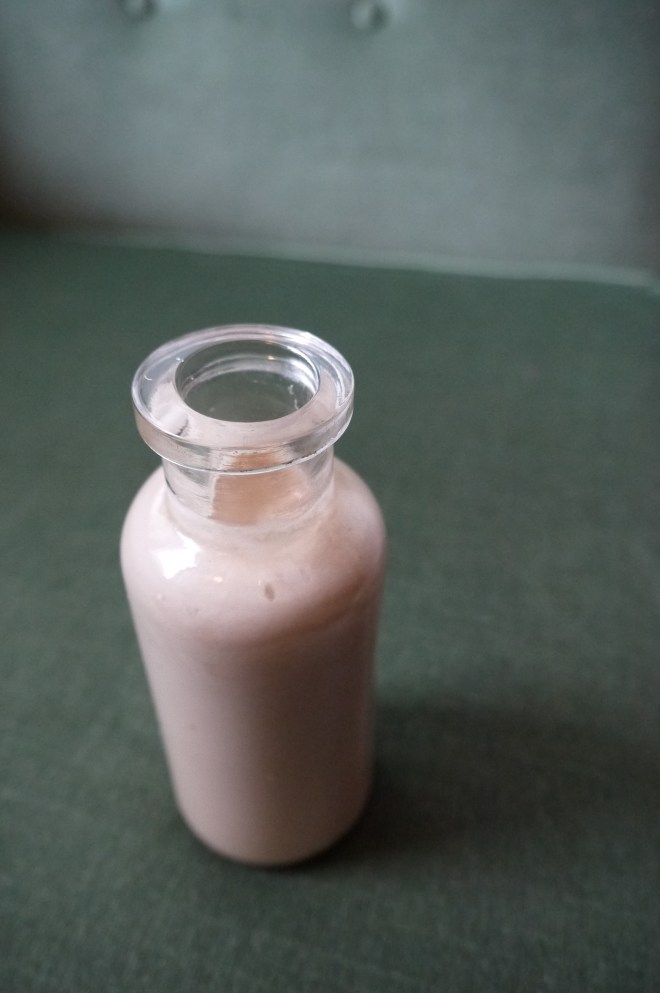
Many years ago I made some homemade Irish Cream, and used a chocolate mould to make Irish Cream chocolates. They were delicious and messy. This winter I decided to try it again, minus the chocolates; so I’d have something different to bring to Christmas parties. The recipe I used before, as most of the ones I was able to find this time around, contain canned condensed milk, chocolate syrup and instant coffee powder. This time I wanted to try a recipe that used fresh cream, home-made chocolate extract, and cold-pressed coffee. And it’s really yummy!

You need to plan a day or two in advance to make the chocolate extract and cold-pressed coffee. I have only included enough ingredients to make enough extract and coffee for this recipe. If you double the recipe for the chocolate extract you will have some left over to add to other recipes, like cakes and brownies.

The Homemade Irish Cream should keep in the fridge for about a month. I know that Bailey’s has no artificial preservatives in it, and it keeps for up to two years because the alcohol and sugar work as preservatives. Let me know how long yours lasts! I’ll be giving mine away, so it won’t last long enough to test the shelf-life.

A few things you’ll need are some bottles for storing the Irish Cream, coffee filters, and a funnel for pouring.

Some of the ingredients settle when it’s in the fridge, so you have to give it a shake before serving.

What you need:

  • 2 tablespoons vodka or whiskey (for chocolate extract)
  • 1 tablespoon dark chocolate cocoa (for chocolate extract)
  • 1/2 cup coarsely ground coffee beans (for cold-press coffee concentrate)
  • 1 cup cold water (for cold-press coffee concentrate)
  • 2 tablespoons  Ghirardelli Bittersweet Chocolate Chips  60% Cacao
  • 2 cups fresh organic cream (I used Avalon)
  • 1/3 cup sugar
  • 1 tablespoon pure vanilla extract
  • 1 & 1/2 cups Irish Whiskey (I used Jameson’s)

What you do:

  1. Two days in advance prepare the chocolate extract: In a small container stir the cocoa, vodka or whiskey, and 1 tablespoon of water. Let this sit at room temperature for the two days, stirring once or twice a day. After the two days, moisten a coffee filter with water, then strain the chocolate mixture. It will take time to strain all the liquid out, but you will be left with a gorgeous chocolate extract.
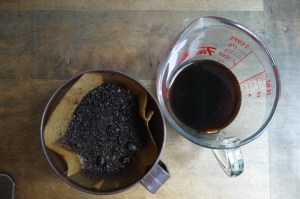
  2. The night before making the Irish Cream you can make the cold-press coffee concentrate: Coarsely grind the coffee beans, then pour them along with 1/2 cup cold water into a jar, making sure all the beans get moistened. Add the other 1/2 cup of the water, then seal the jar and store in the fridge overnight. In the morning you can strain the liquid using a coffee filter.
  3. Using a double boiler over medium-low heat, or a bowl over a pot that has some water in it, place the chocolate chips along with about 2 teaspoons of cream. Stir the chocolate chips until they have melted.
  4. In a bowl whisk the remaining cream and the sugar together. Little by little add the sugar and cream mixture to the melted chocolate, until it has all been incorporated and the sugar has dissolved.
  5. Pour the mixture into a large bowl that has a pouring spout, or into a large jar. Use an immersion blender to pulse a few times to combine, or whisk for a minute. Add the chocolate and vanilla extracts, cold-pressed coffee concentrate, and whiskey. Pulse the blender a few more times to combine.
  6. Use a funnel to pour the Irish Cream into clean jars.
  7. Refrigerate, and enjoy over ice, in coffee, or on top of ice cream. Don’t forget to shake it up first!

P1050873

P1050875